
What to Wear for Trail Running: Head-to-Toe Guide
For most trail runs, you need a wicking top, comfortable shorts or tights, trail-ready socks and one extra layer for the weather. That is the whole kit. The rest is knowing how to adjust it when the temperature, wind or rain changes. At Runner Probs we make funny running T-shirts, hoodies and shorts with moisture-wicking, chafe-free, machine-washable materials. They suit a muddy Saturday loop as well as the road. This guide gives you the outfit, the reasoning behind it and the mistakes that cost runners comfort.
Key Takeaways
- Start simple: bottoms, a top, socks and undergarments are the essential trail kit, and most athletic apparel works on trails.
- Choose quick-drying, wicking fabrics and a fit that does not rub. Comfort matters more than technical specs.
- In the cold, use the add-20-degrees rule and dress to feel slightly cool at the start.
- Carry the layer you might need. Weather on a trail changes faster than in town, and wet clothing in the cold is a safety issue.
- Slogan tees are fine on the trail. What counts is the fabric and the fit.
Table of Contents
- The Short Answer: A Trail Running Outfit in Five Pieces
- A Simple Layering System
- Fabrics: What to Choose and Why
- Fit: How to Avoid Chafing
- What to Wear by Weather
- What to Avoid
- Slogan Apparel on the Trail
- Putting Together Your First Outfit
- Your Trail Outfit, Ready to Wear
- FAQ
- Sources
The Short Answer: A Trail Running Outfit in Five Pieces
You do not need a special trail wardrobe to begin. The trail runners interviewed by iRunFar describe the essentials as bottoms, a top, socks and undergarments. They add that a basic wicking technical shirt can cost under $30 at a sporting-goods shop, so a first outfit does not have to be expensive. Anna Frost, a top international trail runner, tells newcomers they don’t need anything super technical. They need something comfortable that does the job.
Here is the five-piece version:
- Top: a wicking short-sleeve, tank or long-sleeve shirt.
- Bottoms: running shorts, or tights if it’s cold.
- Socks: wicking and durable, ideally made for trail grit.
- Undergarments: a supportive sports bra or underwear that does not chafe on long runs.
- One layer for conditions: a light windbreaker, a hoodie, gloves or a hat, depending on the day.
Shoes, a hydration vest and fuel matter too, but they are gear rather than clothing. This guide stays on what you wear.
A Simple Layering System
If you want a framework, iRunFar describes a layering approach called SVIP. It was created at a running shop and published in 2016. It breaks dressing into four jobs:
- Support: the right undergarment or sports bra.
- Ventilation: the moisture-transfer layer next to your skin.
- Insulation: a heat-trapping layer for cold days.
- Protection: an outer layer against wind, water and sun, plus safety items such as a headlamp or sunscreen.
On a mild day you only need the first two. In winter you add the other two. The point is that each layer has one job, so you can take a layer off or put one on without rebuilding your outfit.
The base layer does the most work
The layer against your skin moves sweat away from your body so it can evaporate. A close but not tight fit works best, because fabric that sits off your skin cannot move moisture. Pick a shirt you already know does not rub under your arms or at your shoulders, since a hundred small rubs add up over a long trail.
Fabrics: What to Choose and Why
Sweat is the enemy of a long run. Fabrics that hold water get heavy, cool you too much in the cold and rub in the heat. iRunFar’s guidance is to look for quick-drying, hydrophobic fibers such as polyester, nylon and rayon, which shed moisture instead of soaking it up.
A few practical notes:
- Technical synthetics are the default for shirts and shorts on any run where you will sweat hard.
- Wool is a good choice for long sleeves and socks. iRunFar notes that wool keeps you warm even when wet.
- Trail socks can be built with friction-reducing fibers, and toe socks wrap each toe to cut rubbing between them. They should also stand up to grit.
- Save your comfortable casual pieces for after the run. A soft tee and hoodie are what you want in the parking lot, at the trailhead brewery or on the drive home.
Our performance pieces are made with moisture-wicking, chafe-free materials that you can wash in a regular machine. That matters on the trail, because trail clothes get muddy and you will wash them often.
Fit: How to Avoid Chafing
Chafing comes from friction, and friction comes from a poor fit, seams in the wrong place or fabric that is wet. Before a long trail run, try your outfit on a short loop. Anna Frost’s point is that we’re all different, so you only find out by trying a piece. Look at these spots:
- Underarms and shoulders: check seams if you wear a hydration vest, because the straps press on your shirt.
- Waistband: it should stay up without digging in when you climb.
- Inner thighs: shorts that are too short or too long can both rub. If you are unsure, try a lined short or a longer inseam.
- Feet: wicking socks that fit snugly, without bunching, help prevent blisters.
A good rule is to wear the exact outfit you plan to use on race day for at least one long training run. Nothing new on race day applies to clothes as much as it does to shoes and fuel.
What to Wear by Weather
Hot and sunny
Choose a light, breathable singlet or short-sleeve shirt in a light color, and shorts. A hat or visor shades your face. Light colors reflect more sun. Because trails often have shade, a thin shirt that dries quickly helps when you move between sunny and shaded sections. Pack sunscreen for exposed stretches, which iRunFar lists under the protection layer.
Cool and mild
A long-sleeve wicking shirt, or a short-sleeve with arm sleeves, covers most days. Shorts or tights depend on your own tolerance. Tie a light layer around your waist if you are in doubt. A hoodie is a good option for the warm-up and the cooldown, and you can pull it off once you are moving. Our running hoodies and sweatshirts are designed for exactly that kind of start-and-stop layering.
Cold
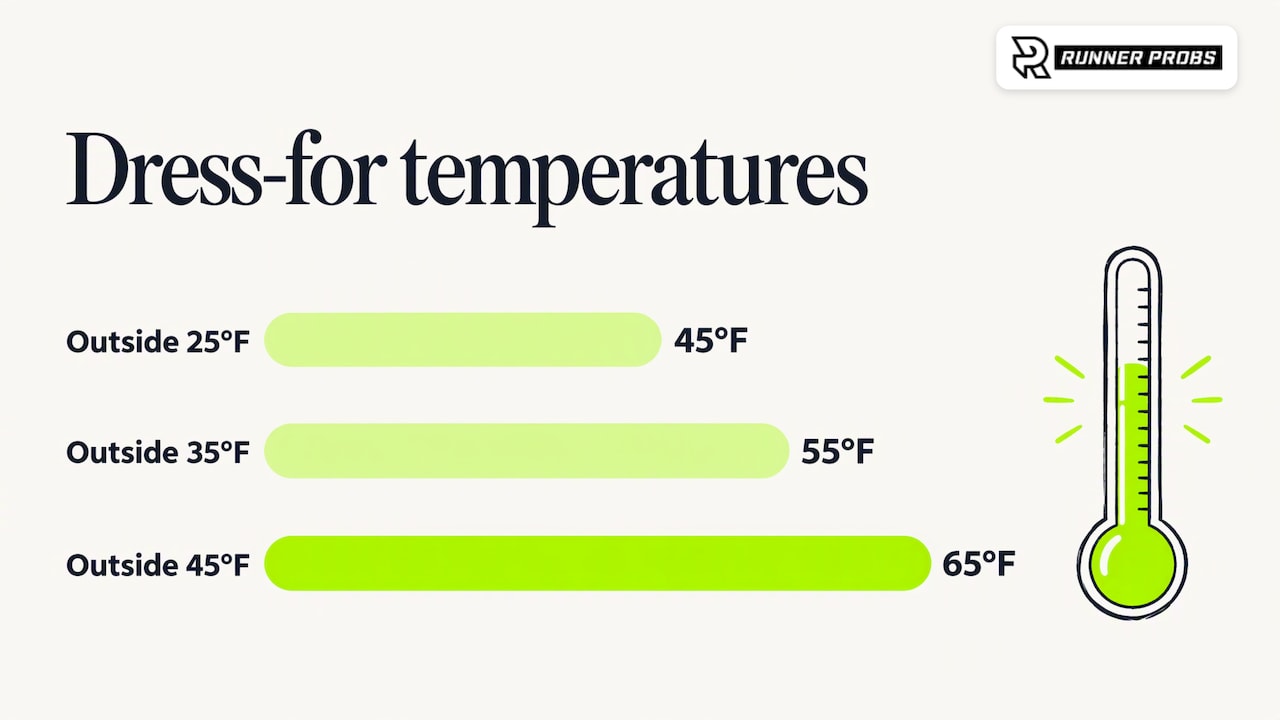
iRunFar offers a simple formula: check the outside temperature, add 20°F, and dress as you would for that temperature in normal life. At 25°F, for example, you would dress as for 45°F. They also advise underdressing slightly, since it’s easier to run a little cold than to overheat and sweat. The logic is that sweat leads to wet, and wet leads to a quick drop in core temperature.
| Outside temperature | Add 20°F, dress for | Typical outfit |
|---|---|---|
| 25°F | 45°F | Long-sleeve shirt, tights, light gloves, hat |
| 35°F | 55°F | Long-sleeve shirt, shorts or tights, thin hat |
| 45°F | 65°F | Short-sleeve or light long-sleeve, shorts |
The outfits in the table are a starting point. Your own tolerance will move you a step either way. iRunFar adds that you should feel a bit cold for the first 10 minutes. If you feel comfortable at the trailhead, you will probably be too warm half a mile later.
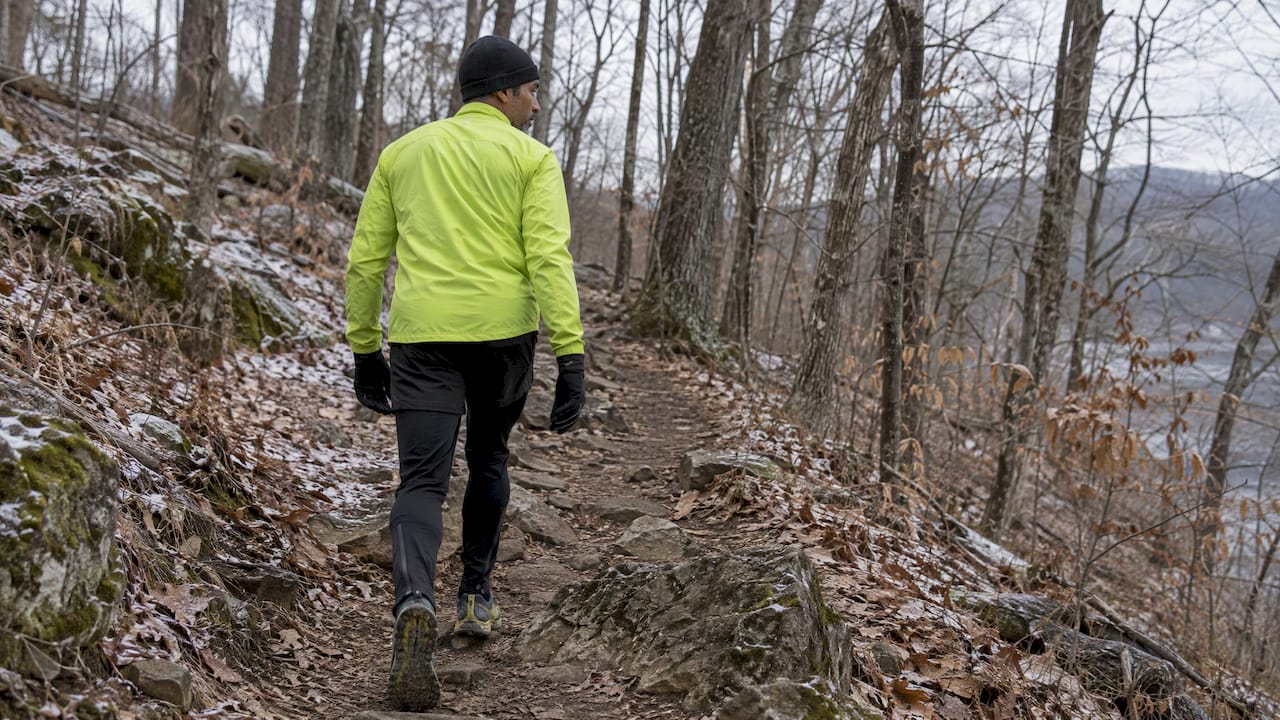
For tights or running pants, pick breathable weights. For the top half, a long-sleeve shirt is the base, and a windbreaker goes over it. Some windbreakers weigh under 3 ounces and some have a water-repellent coating, so they fit in a pocket or vest. For a deeper temperature guide, see our winter running clothing guide.
Gloves, hats and cold hands
Yes, trail runners wear gloves. iRunFar recommends breathable head and hand covers in the cold. When it is well below freezing, a thin fleece glove with an overmitten (wind-resistant, waterproof or insulated) gives you a layer you can strip off quickly. Wool socks hold heat even when wet.
Wet and windy
Rain makes the trail slippery, and wet clothes pull heat from your body. For storms, iRunFar describes a three-layer, seam-taped, ventable waterproof jacket with pit zips. In light rain, a wicking top and a windbreaker are often enough. Wind is the multiplier: a cool day with wind feels much colder once you are sweaty and still.
Wet clothing in the cold is a safety matter, not just a comfort one. The National Park Service says to use water-resistant clothing before you get wet, wear clothing that wicks moisture, minimize wind exposure and replace wet clothes, because hypothermia can happen at temperatures above freezing. If you are caught out in cold rain, head to shelter or the trailhead rather than finishing the loop.
What to Avoid
- Tight garments that restrict movement. Trails need a full stride and room to climb.
- Anything new on a long run. Test every piece on a short loop first.
- Too many layers at the start. You will warm up fast, and sweat is what makes you cold later.
- Thin socks that bunch. Blisters end runs.
- Heavy, baggy items that flap or catch on branches. Choose a fit that stays put.
Slogan Apparel on the Trail
You can run in something that makes you smile. Trails are social: you pass the same hikers, runners and dog-walkers, and a good slogan starts a conversation at the aid station. A shirt that says “Will Run for Tacos” or “Every Mile Is a Mood” does the same job as a plain one, as long as the fabric wicks and the fit does not rub.
Our designs are created by runners for runners, and we make them in performance styles for training and race day, as well as casual styles for after. If you are building a trail outfit, start with a running shirt for the base layer and add shorts with funny sayings for the bottom half.
Putting Together Your First Outfit
Here is a practical way to build it without overbuying:
- Pick the weather you run in most. If you run in mild spring and fall, start with one wicking shirt and one pair of shorts.
- Add one layer. A light hoodie or windbreaker covers cold starts and surprise wind.
- Buy two tops. Trail clothes get muddy, and having a spare means you can run on consecutive days.
- Test on a loop. Run 20 to 30 minutes in your outfit and note any rubbing.
- Fill in later. Gloves, a warm hat and a rain jacket can wait until the season calls for them.
Your Trail Outfit, Ready to Wear
A good trail outfit is mostly ordinary running clothes that wick, fit and let you move. If you want yours to have a sense of humor, our funny running T-shirts, hoodies and shorts are designed with moisture-wicking, chafe-free, machine-washable materials. Our site is organized by garment type, color, size and slogan, so you can find a favorite quickly.
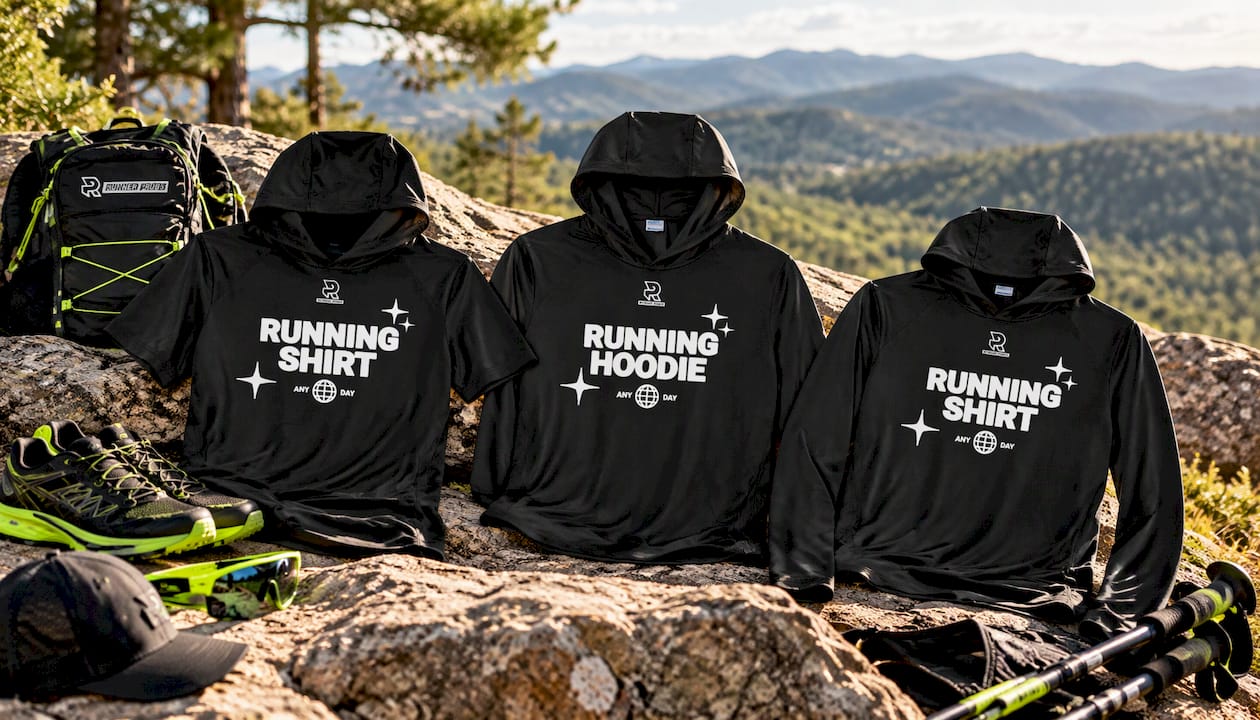
Browse the full range on our shop page. If you are buying for a runner who hits the trails, the running gift guide has ideas for every budget.
FAQ
Can you wear regular running clothes for trail running?
Yes. iRunFar’s trail-running writers say most athletic apparel translates to the trails. Wicking shirts, running shorts and good socks are the core of the kit. Trail-specific features, such as durable socks or a pocketed vest, are helpful extras.
What should I wear on a trail run in cold weather?
Use the add-20-degrees rule: at 25°F, dress as you would for 45°F. Start with a wicking long-sleeve shirt and tights or running pants, then add a windbreaker, a hat and gloves as needed. You should feel slightly cold for the first 10 minutes.
Do trail runners wear gloves?
Yes, in the cold. Thin, breathable gloves work for cool days. When it is well below freezing, a thin fleece glove with an overmitten gives you warmth you can remove quickly if you heat up.
Is cotton okay for trail running?
For the run itself, choose quick-drying, wicking fabrics such as polyester or nylon, which move sweat away from the skin. Soft cotton pieces are a great choice for the post-run stretch, the drive home and the rest of the day.
Sources
- Dress For Success: How To Dress For Trail Running, iRunFar
- Trail Tools, Part 2: Clothing, iRunFar
- Water Safety, Devils Postpile National Monument, National Park Service