
Half Marathon Outfit: What to Wear on Race Day
The best half marathon outfit is one you have already run a long training run in: a moisture-wicking top, shorts or tights that don’t rub, synthetic socks and a layer you can shed at the start line. Everything else is weather and personality. You will spend somewhere between one and three hours in these clothes, so pick pieces that stay dry and quiet against your skin, then add the slogan that makes you smile at mile 10. That is the idea behind our funny running T-shirts, which pair moisture-wicking, chafe-free, machine-washable fabric with designs written by runners.
Key Takeaways
- Build the outfit from fabric first: synthetic, moisture-wicking pieces, never cotton, from top to socks.
- Dress as if it were about 20 degrees warmer than the forecast, because your body heats up once you are moving.
- Wear the full race outfit on at least one long run, and use anti-chafe balm on every rub point.
- Start with a throwaway layer on cold, windy or rainy mornings and shed it before the gun.
- Choose a top you love: a funny or motivational slogan is free motivation when the miles get long.
Table of Contents
- The Five Pieces of a Half Marathon Outfit
- What to Wear for a Half Marathon by Temperature
- Preventing Chafing in a Half Marathon
- Test Your Race Outfit Before Race Day
- Choosing a Shirt That Is Funny and Race-Ready
- Your Race-Day Outfit From Runner Probs
- Race Morning: What to Bring Besides What You Wear
- FAQ
- Sources
The Five Pieces of a Half Marathon Outfit
A half marathon is 13.1 miles. That is long enough for a small annoyance, such as a seam or a damp shirt, to become the only thing you think about. Every piece should therefore do one job well.
Top
Choose a snug, technical top: a running T-shirt, a tank or a singlet. Coaches recommend a tight-fitting base layer made of technical polyester or nylon that wicks sweat and dries fast. Cotton does the opposite. It stays wet and feels rough against skin, which is exactly how chafing starts.
This is the piece where your personality goes. A performance tee with a slogan like “Run Now. Wine Later.” or “Every Mile Is a Mood” is also your finish-line photo, so it deserves a little thought. Our performance tees are made with moisture-wicking, chafe-free fabric, so the joke does not cost you comfort.
Bottoms
The options are baggy shorts, spandex shorts, tights, capris or a skirt. The goal is to cut down on rubbing, which is why fitted capris or shorts tend to suit long distances better than loose, flappy ones. Pick whichever length you have already trained in, and check that nothing rides up or bunches at the waistband. Browse our running shorts if you want a pair that matches your training mindset.
Socks
Choose running-specific socks in a polyester or nylon blend, or merino wool, which wick moisture and let your feet breathe. Avoid cotton and avoid socks with holes, since a hole is a blister waiting to happen, as Prisma Health points out.
Shoes
Shoes are not the place for experiments. Race in a pair that is well broken in, because comfort is the priority. If you do want a fresh pair, a sports-medicine physician quoted by Prisma Health suggests wearing new shoes for at least two weeks before the race. Mass General Brigham also advises replacing running shoes every 350 to 500 training miles and not tying laces too tight, so your toes can wiggle. Runners with a history of bone stress injuries should talk with their doctor before choosing carbon-plated race shoes.
Accessories
The usual list is a race belt or a pinned bib, sunglasses that don’t bounce, a hat or visor to keep sweat out of your eyes, a moisture-wicking headband, and a way to carry fuel and water, such as a fuel belt or handheld bottle. Hats are a natural fit for the slogan crowd, and a visor is the easiest way to add a joke to a serious outfit.
What to Wear for a Half Marathon by Temperature
Race-morning weather decides the layers, not the calendar. Two rules cover most of it.
Dress warmer than the forecast says you are. The Boston Athletic Association’s half marathon athlete guide tells runners to dress as if it is 20 degrees warmer than the actual temperature, since you warm up once you get moving. TrainingPeaks uses a more conservative 10 degrees and adds a useful test: if you feel a little cold at the start, you are dressed correctly.
Check the forecast for the start time. Look a few days out, and again the night before. The start-line temperature is what matters, and a run that finishes in the sun can still start in the cold.
A quick guide
| Start-line temperature | What to wear | Add if needed |
|---|---|---|
| 65°F and above | Singlet or light tee, shorts | Visor, extra sunscreen and anti-chafe |
| 50 to 64°F | Short-sleeve performance tee, shorts or capris | Light long sleeve or arm warmers, thin gloves |
| 40 to 49°F | Short-sleeve wicking tee or tank, shorts or capris | Arm warmers, gloves, headband, throwaway layer |
| Below 40°F | Wicking base layer, looser second layer, wind-resistant outer layer, tights | Mittens, hat or ear cover, throwaway layer |
This table applies the dress-warmer rule to the guidance in the sources above. Treat it as a starting point and adjust to how you run hot or cold.
How to dress for a half marathon at 40 degrees
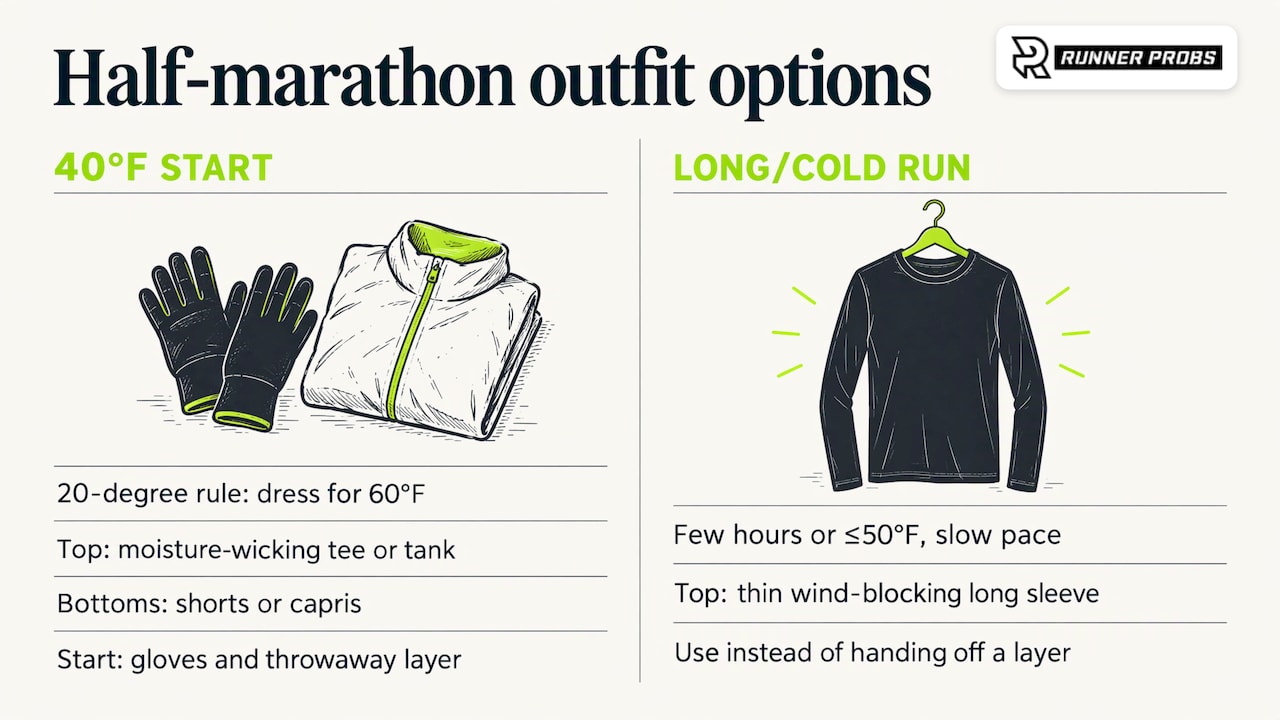
A 40-degree start is a very common race morning, and it is where many runners overdress. Because of the 20-degree rule, you are dressing for roughly 60. That usually means a moisture-wicking short-sleeve tee or tank and shorts or capris, with arms and bra lines protected against chafing. For the start, add gloves and a throwaway layer. Light gloves are worth carrying even at 50°F, since cold hands can make a runner miserable.
If you will be out for a few hours, or it is 50°F or lower and you run slowly, a thin long-sleeve shirt that blocks wind without holding heat is a smart middle option. A sports-medicine physician quoted by Prisma Health suggests it as an alternative to handing off an extra layer before the start.
Cold, windy or rainy mornings
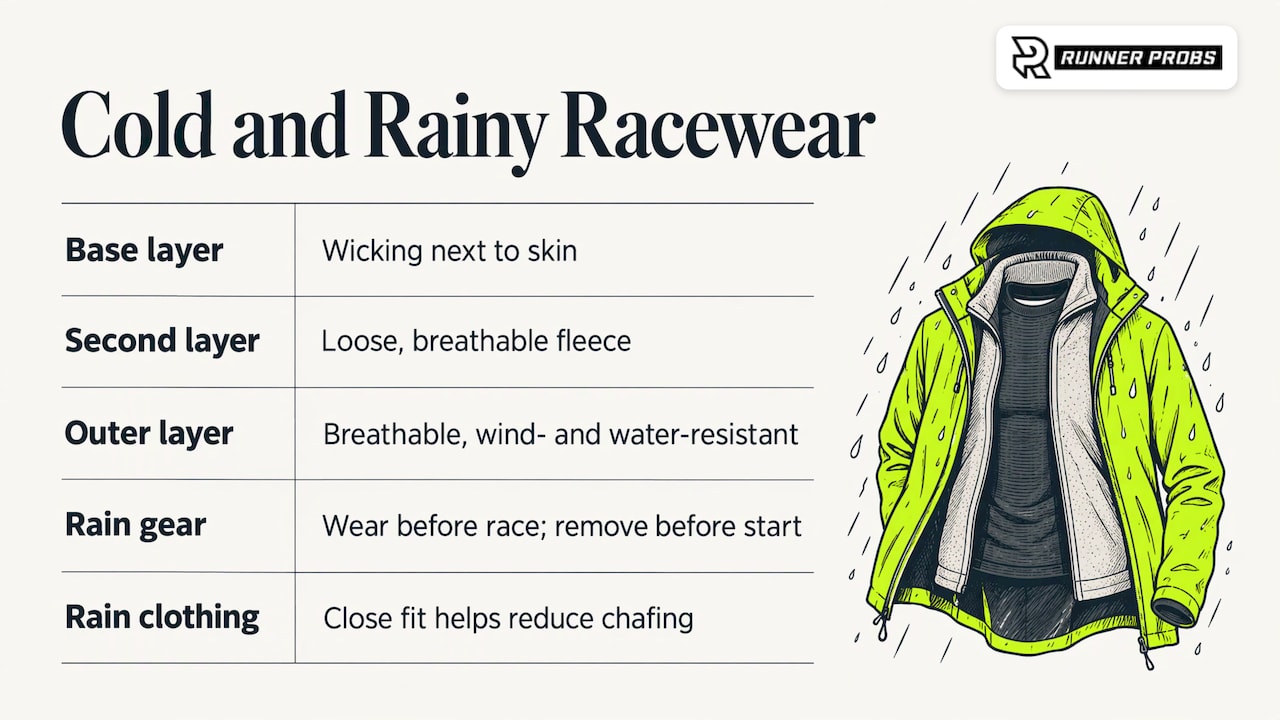
For a properly cold race, the Boston Athletic Association describes three layers: a wicking base next to the skin, a looser, breathable second layer such as fleece, and a breathable, wind- and water-resistant outer layer. It also notes that an uncovered head accounts for about 40% of heat loss, and that mittens are warmer than gloves. Our temperature-by-temperature winter running guide goes deeper on the colder end.
Rain does not call for a big wardrobe change, because your body heats up quickly. Wear a raincoat or extra layers before the race and take them off before the start. Choose close-fitting, moisture-wicking, ideally seamless clothing, since rainy conditions cause more chafing than dry ones.
The throwaway layer
An old sweatshirt or long-sleeve tee from the thrift store keeps you warm in the corral and then comes off. Many races donate discarded clothing to a local charity, so toss it at the side of the course rather than carrying it.
Preventing Chafing in a Half Marathon
Chafing is the number one outfit problem over 13.1 miles. According to Mass General Brigham, it happens when fabric rubs against skin for extended periods. The most common spots are between the thighs, the arms and torso, and where the chest meets the shirt. Verywell Fit adds the bra line for women, the nipples for men, and the underarms as typical trouble areas.
Your plan has three parts:
- Pick the right fabric and fit. Synthetic, moisture-wicking pieces that sit close to the body, with as few seams as possible in the rub zones.
- Lubricate the vulnerable spots. Mass General Brigham recommends petroleum jelly where rubbing occurs. Verywell Fit suggests a thin layer of an anti-chafe balm or Vaseline if clothing alone does not solve it. Prisma Health suggests baby powder before the race on areas prone to blisters and chafing.
- Know the plan B. Some courses offer petroleum jelly at water stations if chafing starts mid-race.
Apply it earlier than you think you need to. If a spot has ever rubbed on a long run, it will rub on race day. If you have broken skin, a rash or an ongoing skin condition, ask your doctor before trying a new product.
Test Your Race Outfit Before Race Day
“Nothing new on race day” is the cardinal rule, and it includes the free shirt from the expo or your swag bag. New gear can chafe, feel too tight or too loose, or turn uncomfortable after the first few miles, and Verywell Fit recommends wearing your planned outfit on long runs so you can adjust it.
Here is how to do a proper dress rehearsal:
- Pick the outfit about a week out, once the forecast starts to settle.
- Wear all of it on a long run, including socks, hat, belt and the shirt you plan to wear. Runner’s World gear experts point out that long runs are also practice for logistics: where gels sit in your pockets, and whether a waistband rubs.
- Run at race effort in similar weather if you can. Small problems that don’t show up at an easy pace can become distracting mid-race.
- Apply glide to the chafe points during the test, as you will on race morning.
- Wash it the way you always do. One runner quoted by Polar notes that even the detergent should stay the same if you have sensitive skin.
Our items are made to order, so it helps to place your order well before race week. That leaves time for at least one real long run in the shirt, plus a wash, before the start line.
Choosing a Shirt That Is Funny and Race-Ready
Humor is not a gimmick in a half marathon. Around mile 9 or 10 the miles feel long, and a spectator reading your shirt and laughing out loud is a real lift. A few ways to pick:
- Match the slogan to your race mood. “Will Run for Tacos” suits a post-race-brunch crowd, while “Pace? I Hardly Know Her” is for the runner who is happy to be there.
- Go performance for the race, cotton for after. Wear a wicking performance fabric for 13.1 miles, then switch to something casual for the celebration.
- Think about the finish-line photo. Light colors are another recommendation from Prisma Health, as they handle sun better on warm race days.
- Plan the after-race layer. A hoodie waiting in your bag or with a friend keeps you from getting cold once you stop moving.
Runners who have finished a big one can also look at our marathon finisher designs, which are a natural keepsake after a long-distance race. For everyday training, the running shirt collection has options for every mood.
Your Race-Day Outfit From Runner Probs
If you are building your outfit now, start with the top, since it is the piece with the most personality. We make funny running T-shirts, running shorts and running hoodies and sweatshirts with original slogans designed by runners for runners. The fabrics are moisture-wicking, chafe-free and machine-washable, which is what a long-run test needs.

Free domestic shipping applies on orders over $150, which makes it easy to pick up a tee, shorts and a post-race hoodie in one order. You can browse everything in our full funny running apparel shop.
Race Morning: What to Bring Besides What You Wear
The outfit is the main thing, but a few extras make the morning smoother.
- Throwaway layer for the start corral, as covered above.
- A bib on a race belt or pinned to your shirt, ideally the night before so you are not hunting for pins.
- Fuel and hydration, such as gels, a handheld or a belt, packed the way you practiced on your long runs.
- Anti-chafe balm, which is small enough to tuck into a bag and apply in the car.
- Post-race clothes: dry socks, a dry top and a warm layer. A marathon finisher hoodie is a comfortable choice for the walk back to the car.
- A backup outfit for the days before, laid out and washed. One runner interviewed by Polar starts tracking the weather a week ahead and keeps all her outfit options washed and ready.
If you are shopping for a runner rather than for yourself, our funny gifts for runners guide and the marathon finisher gift guide are good places to start.
FAQ
What should I wear for a half marathon?
Wear a snug, moisture-wicking top, shorts or tights you have already trained in, running-specific socks and broken-in shoes. Add a hat or visor, a race belt and a throwaway layer if the start is cold. Skip cotton everywhere, since it holds sweat and rubs.
How do I dress for a half marathon in 40 degree weather?
Dress for about 60, since you will feel roughly 20 degrees warmer once you are running. A wicking short-sleeve tee or tank, shorts or capris, and anti-chafe balm form the base. Gloves and a throwaway layer keep you warm at the start. If you will be out for a long time, a thin long sleeve is an option.
Should I wear something new on race day?
No. New clothes can chafe, bunch or feel wrong after a few miles. Wear the exact outfit, including socks and hat, on at least one long run first, and keep your detergent the same.
What should I bring to a half marathon besides my outfit?
Bring your bib and race belt or pins, fuel and hydration you have practiced with, anti-chafe balm, an old layer to toss at the start and dry clothes for afterward. Sunglasses and a visor help on sunny courses.
Sources
- Half Marathon Gear: What to Wear (Mottiv)
- Half Marathon Gear: Shoes, Clothing & Race-Day Essentials (Runner’s World)
- Info for Athletes, Boston Half (Boston Athletic Association)
- Tips for running your first 5K or half marathon (Prisma Health)
- Marathon Training Plan (Mass General Brigham)
- 16 Things to Know About Running a Half-Marathon (Verywell Fit)
- How to Train for Your First Half Marathon (TrainingPeaks)
- What to Wear for a Half Marathon (RunToTheFinish)
- Planning your race day outfit (Polar)